
Compound Interest and Habits
Why you should be thinking about building habits with compounding returns
What I’ll cover:
How everyone can become a millionaire
Compound time
Habits that compound
Compound interest is a well-known concept that’s taught in Economics 101 classes around the world, but its importance in personal finance cannot be overstated and is often missed. Let’s start with a quick example.
If you have $1,000 that you want to invest, you can put it in an index fund that tracks the stock market to earn 7.5% annual interest based on the average of the last 100 years. At the end of the first year, you’ll earn $75 dollars in interest, so you’ll have $1,075. The next year, you’ll earn interest on the $1,075, so you’ll get $81. As more time goes by your investment starts to increase exponentially. Compound interest is the interest that you earn during one period earning you more interest during the next period.
The following visual assumes that you start with $1,000 and invest $500 every month for 50 years:
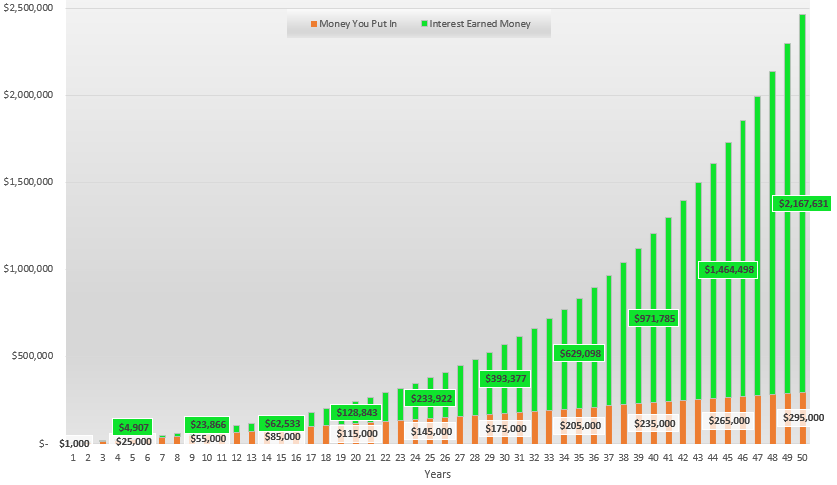
After those 50 years, you’ll have put in a total of $295,000. Congratulations - this is essentially what you would have if you put the money in a low-interest savings account or buried it in the backyard. You’re better than that, though, and thanks to compound interest, you’ll actually have more than 2 million dollars. An important lesson here is that the earlier you start, the more you’ll end up with because in the later years you’re earning interest on a much bigger pile.
What are compounding habits?
I recently came across the thought process of how most returns in life relate to compound interest, whether it’s wealth, health, relationships, or knowledge. I haven’t been able to stop thinking about it since.
I’ve boiled it all down to compound habits. The habits you develop that determine where you consistently spend your time will play a massive role in your future returns.
Think of it this way: if you use your free time to concentrate on areas that push you to improve, you will improve in that area and it will get easier and easier as you go. If you decide to spend 30 minutes a day learning piano, it might be quite hard for a while, but if you stick with it long enough you’ll become an expert. Then maybe you’ll write your own composition for the world to see. Say that gets noticed by a movie producer looking for a film score for their new movie. You get selected to create it and once released, the movie shatters box office expectations. You earn royalties on the movie soundtrack and you’re now a hot commodity amongst famous movie producers. You have a huge platform to share your new compositions.
You get the idea. My point is that it all starts with those first 30 minutes you spent learning piano. What you’re throwing out by not spending those 30 minutes is everything that you might’ve gained. If you delay starting, you’re sacrificing the compounding gains in the later years because it’s going to take longer to get there.
I’m not saying you should drop everything and learn piano, but if there’s a particular area that you’re passionate about progressing in, you should start today. You’re going to suck at first, but that’s fine because the big returns come later down the line.
What we are able to make out of this life really just comes down to our habits. It’s important to establish good habits and iterate on them while observing what needs to be improved.
Here are a few habits that I’ve found to have compounding returns:
Writing
Meditating
Exercise
These are all super easy to get started with, but I’ve found that spending the time consistently doing these habits has a massive effect on my awareness, energy, and mood. I’ll dive deeper into these topics in another post.
Thanks for reading and be sure to subscribe for future Coffee Break publications!